
Subscriptions and microtransactions have transformed online gaming. Payments are evolving from a technical step into a key element of the gaming business

Online gaming is no longer just a casual hobby for a handful of PC players. According to report by Newzoo, the global games industry reached around USD 188.8 billion in revenue in 2025, with the global player base approaching 3.6 billion people. Estimates based on the same data suggest that in 2026, the global gaming market could approach $205 billion, with nearly four billion players by the end of the decade.
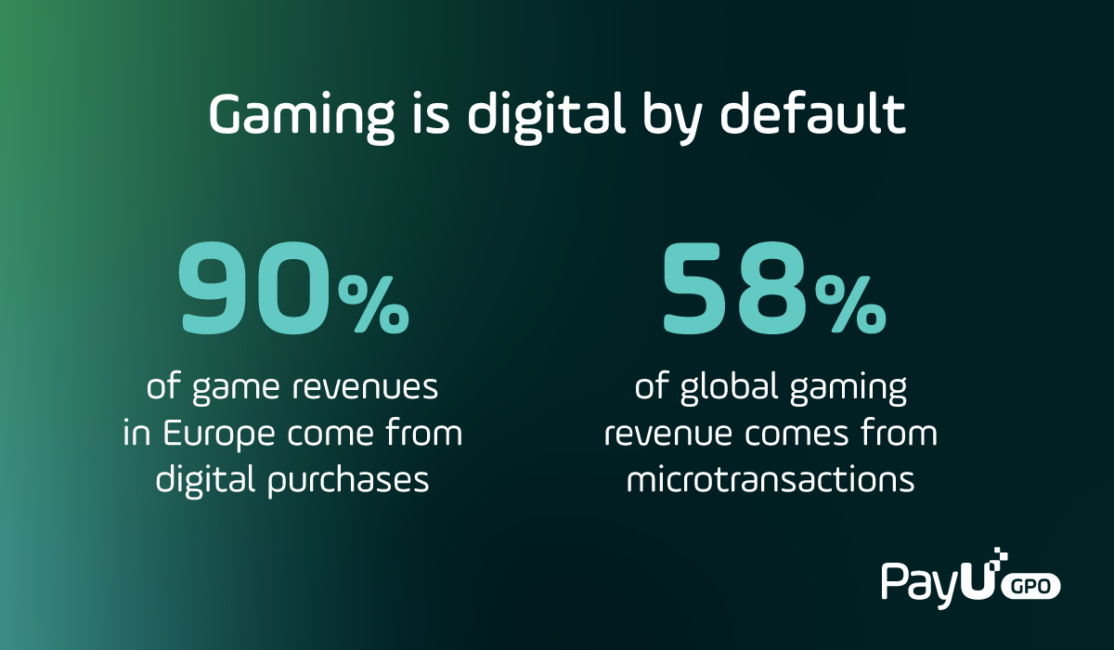
The industry has also gone overwhelmingly digital. According to the Video Games Europe association, 90% of game revenues in Europe now come from digital purchases, while physical copies only account for a small fraction of the market. Global forecasts predict that this year up to 95% of game sales will be purely digital. Players no longer buy “one game per year”, instead, they continuously spend on in-game currencies, skins, DLCs, battle passes and subscriptions. Newzoo data shows that these microtransactions now generate 58% of total global revenues, which represents roughly USD 24.4 billion a year.
In practice, this all points to one thing: payments have become one of the key pillars of the gaming business. How fast and seamless you let players pay has a direct impact on your revenue, loyalty and ability to expand into new markets. And this is exactly where having a strong payment partner like PayU by your side becomes interesting.
Year after year, gaming is taking up a larger slice of the digital spending pie. It has grown from a niche pastime into a true engine of the online economy, with huge communities, regular seasons and content that evolves dynamically throughout the year.
From a payments perspective, it’s a very specific mix:
This is where it becomes clear that payments are not just a necessary “layer” between the player and your bank account. In a world where game revenues are nearing USD 200 billion and most of that flows through digital payment gateways, the payment experience is part of your product.
At first glance, a game purchase might look like any other checkout. But gaming has several unique characteristics that mean any friction in the payment flow is immediately felt in both business performance and player satisfaction.
Impulsive shopping is strong – A player has just finished a match or a level, is happy with the game, but hit a limit that they can solve with an extra in-game currency. The impulse to buy is strong, but brief. As soon as the payment takes too long or forces them through several extra screens, the emotion fades and so does the transaction.
Global players, local preferences – A single title can have a huge player base in completely different regions, from Western Europe to Latin America and Asia. While card payments still dominate in some markets, in othersplayers naturally reach for instant bank transfers, QR payments or digital wallets.
Microtransactions at scale – Unlike a traditional online store, games are often built around repeated purchases of varying amounts, several times a week, sometimes even daily. This raises the bar for costs, speed, and system stability, because any small friction is multiplied quickly at scale.
Subscriptions and seasons – Battle passes, VIP memberships, seasonal access or regular content packs, all of these models rely heavily on recurring payments. Players expect to choose a method once, give their consent and not worry about it again until they decide to change or cancel the service. This is where saved cards and smart recurring billing come into play.
At a time when gaming accounts for a significant share of the digital economy, one simple question arises: how much money is a merchant leaving on the table because of a poorly designed payment setup?
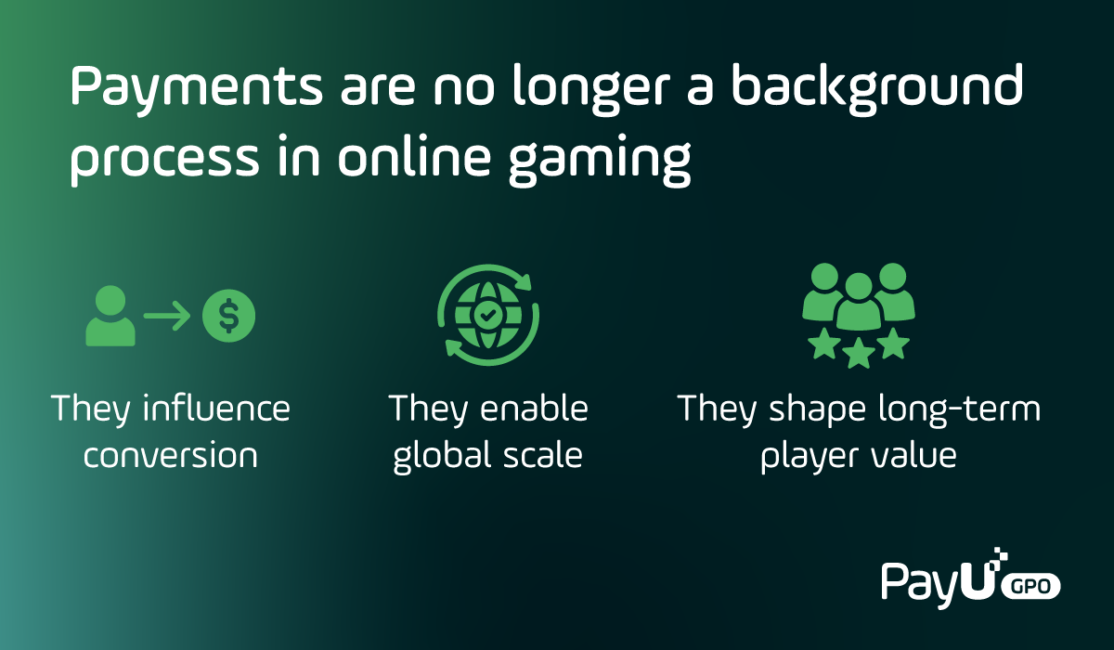
One thing is to make payments technically work. Another is to make sure they:
A strong payment partner helps turn payments from a necessary step into a real growth lever, whether that’s higher conversion at checkout, faster international expansion, or simply the confidence that your product team can rely on payments to keep up with their ideas.
In this delicate balance between business, player experience and technology, you need a partner who understands digital verticals and can also think locally in each market. This is exactly where PayU has a strong position, and gaming is a natural playground for it.
Instead of patching together multiple providers, game studios and platforms can integrate with PayU and gain access to a wide range of payment methods in local currencies. This simplifies technical integration, reporting, and day-to-day operations and, most importantly, speeds up market entry.
A player in Poland, Czechia or Brazil expects to see “their” way to pay: a bank transfer, a QR code, a digital wallet or a card they use everywhere else. PayU can offer a mix of global card schemes and local payment methods so that the checkout feels natural in every market.
From a technical point of view, gaming is a combination of huge numbers of small payments and recurring transactions. PayU can work with saved cards, so players can save payment details for next time, and with recurring billing for different types of subscriptions. The focus is on ensuring payments run reliably in the background and don’t interrupt the gaming experience in any way.
Thanks to reporting and analytics, game platform operator can see how payment success rates differ by country, device or method, where transactions drop off and where it makes sense to experiment. In a segment as data-driven as gaming, this is a huge advantage, you can optimise payments with the same discipline you apply to your in-game economy or retention curves.
If you add up all the numbers, revenues close to USD 200 billion, almost four billion players, more than half of income coming from microtransactions and the dominant share of digital purchases – it’s clear that gaming today represents a massive part of the digital economy. In such a world, payments are no longer just a technical detail in the background.
They become part of game design:
A strong payment partner isn’t just there to “process a transaction”. They’re there to help gaming merchants unlock the full potential of the gaming boom.